This past month I gave talks and helped lead AI workshops for more than 150 CEOs: at Anthropic HQ in San Francisco, H.I.G. Capital's ENGAGE Summit in Chicago, and GIC's office in New York. Between them they run organizations with tens of thousands of people. I showed them not only how to think about AI agents but how to build their own, for the job they do themselves: a chief of staff, a finance agent for board prep, and an operating dashboard for their leadership team. A substantial number were, in their own words, mind blown.
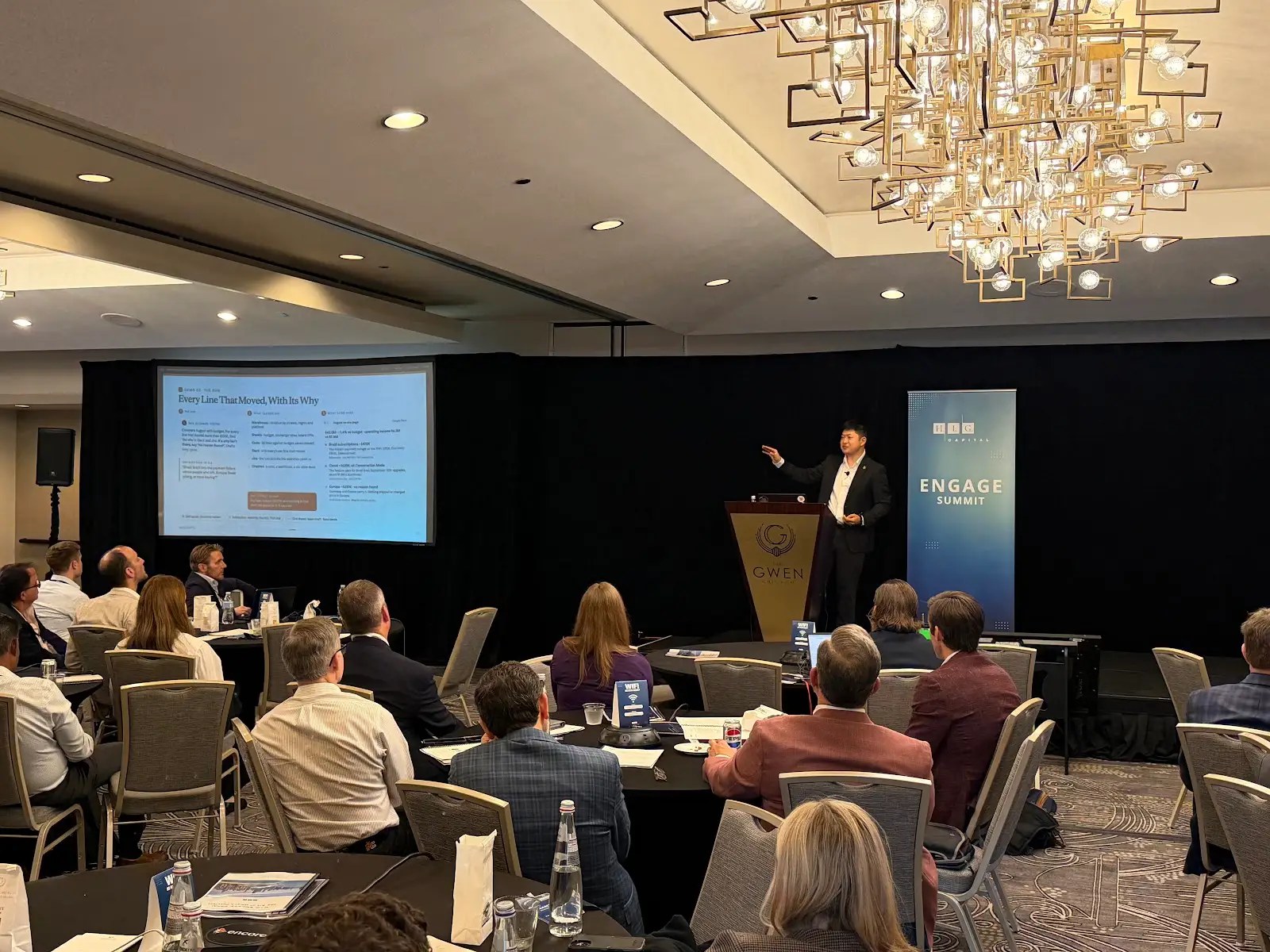
That reaction told me where the problem is. Much of what is slowing AI transformation is that it has reached the CEO's agenda but not the CEO's own work. I think AI transformation needs two owners, and the one companies most often skip is the CEO.
This is written for CEOs. But I believe AI applies to anybody in the workforce, and so does most of what follows.
Every wave before this one could be handed off
For sixty years, a CEO could delegate technology and lose nothing by it. Every wave on this chart, from semiconductors to mobile, gave companies a new layer to run, and each layer got its own department. The CEO approved the budget, read the reports, and kept doing the same job.
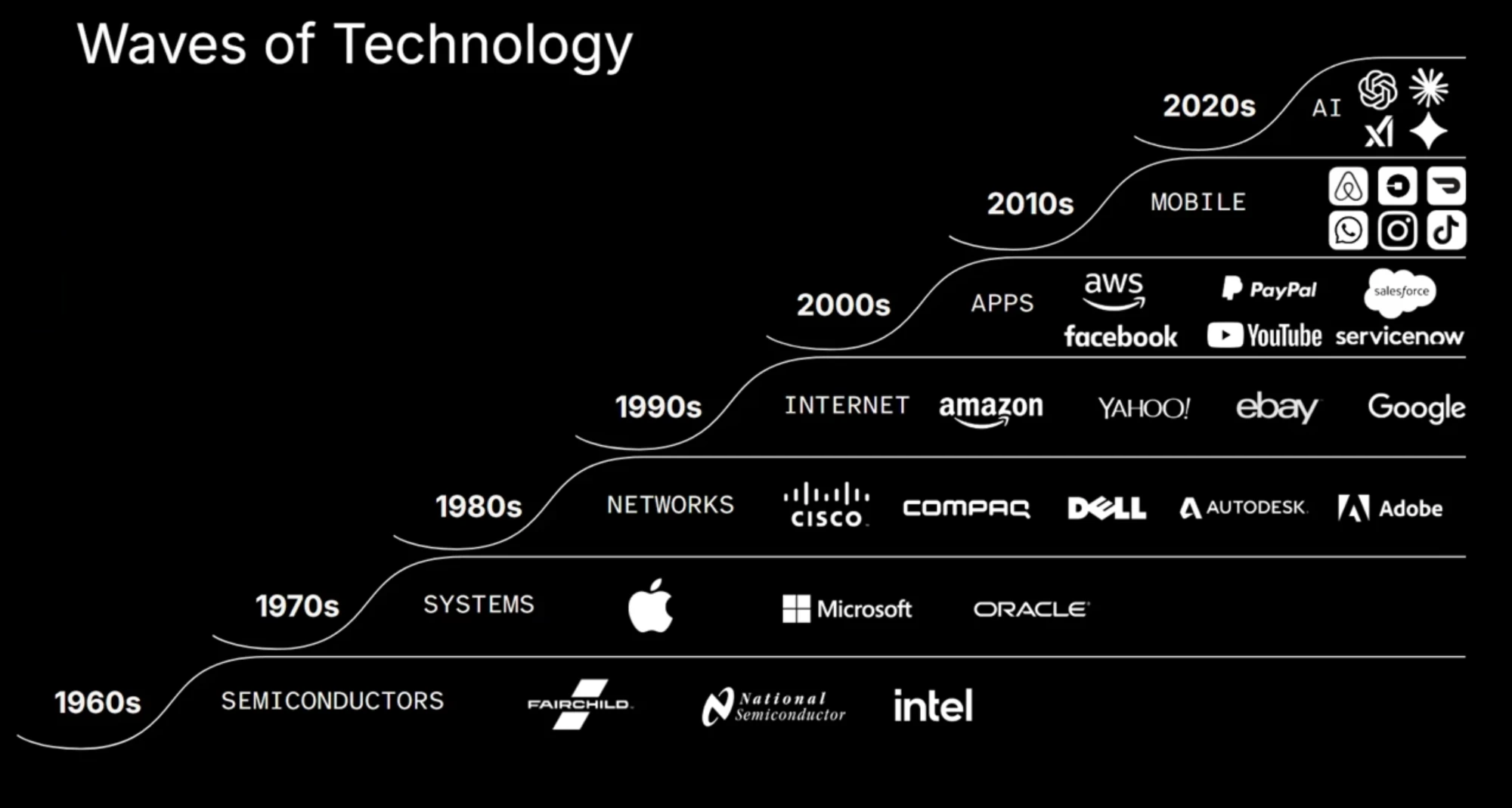
Chart from @gradypb on X.
That was the right call, and a generation of leaders got very good at it. AI breaks the habit. It does not add a layer for someone else to run. It does a piece of the work itself, and it can do a piece of everyone's work: the analyst's, the manager's, and the work of the person running the company. In an earlier essay I wrote that AI cannot be delegated to engineering. After a month with CEOs, I think it goes further. It cannot be handed down at all.
Nobody had pointed it at their job
CEOs rarely get to play with new technology. They spend their time on the biggest problems in the organization, and the tools usually reach them as someone else's demo. So we skipped the tour and helped them build for the CEO's own week.
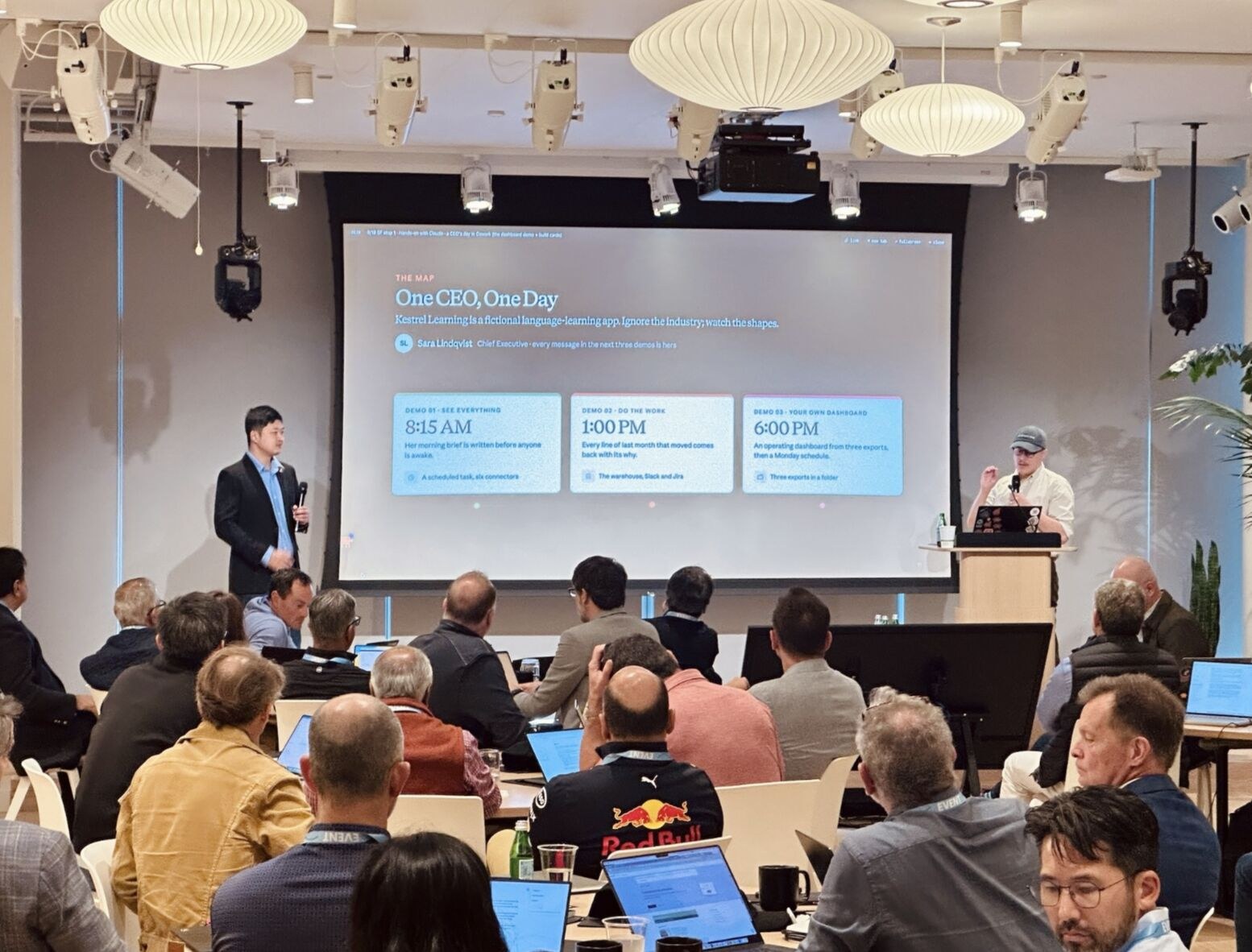
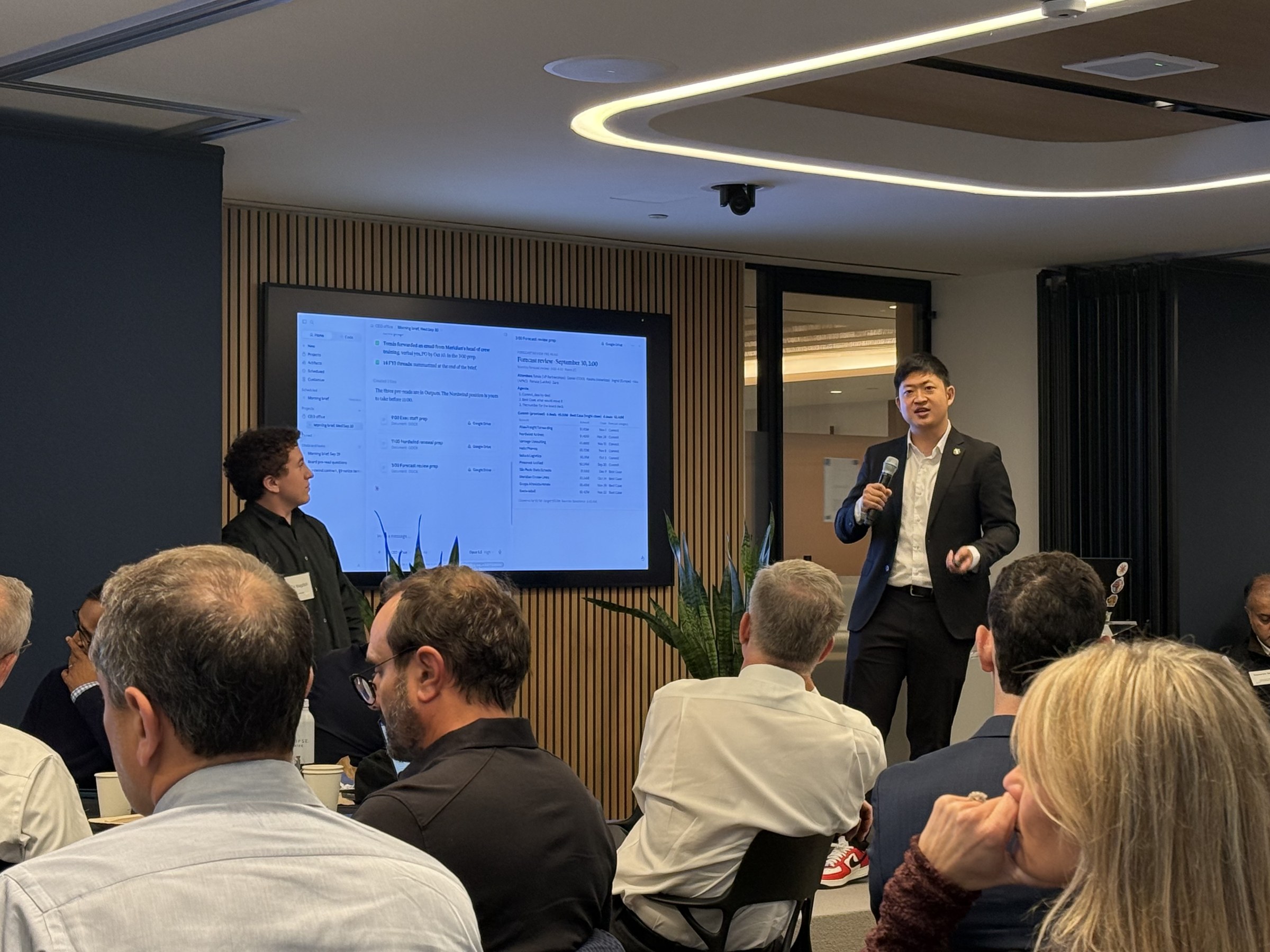
The first build was a chief of staff agent that goes through everything on your behalf and helps you see what you actually spend your time on. The second was a finance agent for board preparation. It checks that the numbers line up with the story you are trying to tell, and flags what you would have had to flag anyway, before a board member does. The third was an operating dashboard the agent builds as a working web app for the whole leadership team, where each person sees only what their own access already allows. The CEO sees the company. A regional lead sees the region.
The room changed when AI stopped being something for their engineers and became useful for the job they do themselves. The larger the organization, the more of that job is coordination: reading, reconciling, preparing, deciding. That is exactly the work AI is good at, and it is not a tech-company advantage. Every company now runs on software, whether you make SaaS or dish soap. The dish soap company has a forecast, a board deck, a supply chain plan, and thousands of people whose week is mostly coordination.
A champion is not an owner
Once a CEO has felt it, the next question is who carries it across the company. The tempting answer is an AI champion, an enthusiast with influence and no mandate. A champion can start a pilot. A champion cannot tell the finance team to change how the close runs, or move budget from one function to another, so the pilot impresses people and stays where it started.
Several of the companies furthest along, by their own account, had done something different. They named an executive owner with a straight line to the CEO and a mandate to go across the entire organization, find every workflow AI can carry, and set every team up to use it as fully as it can. The title does not matter. It can be a COO, a CTO, or a Chief AI Officer. What matters is two things: the CEO's visible buy-in, and real authority to roll AI out, meaning the power to change how a team works and to move budget when the work moves. For these companies AI was not another tool to roll out. It was a new dimension of the business, and it had an owner the way revenue has one.
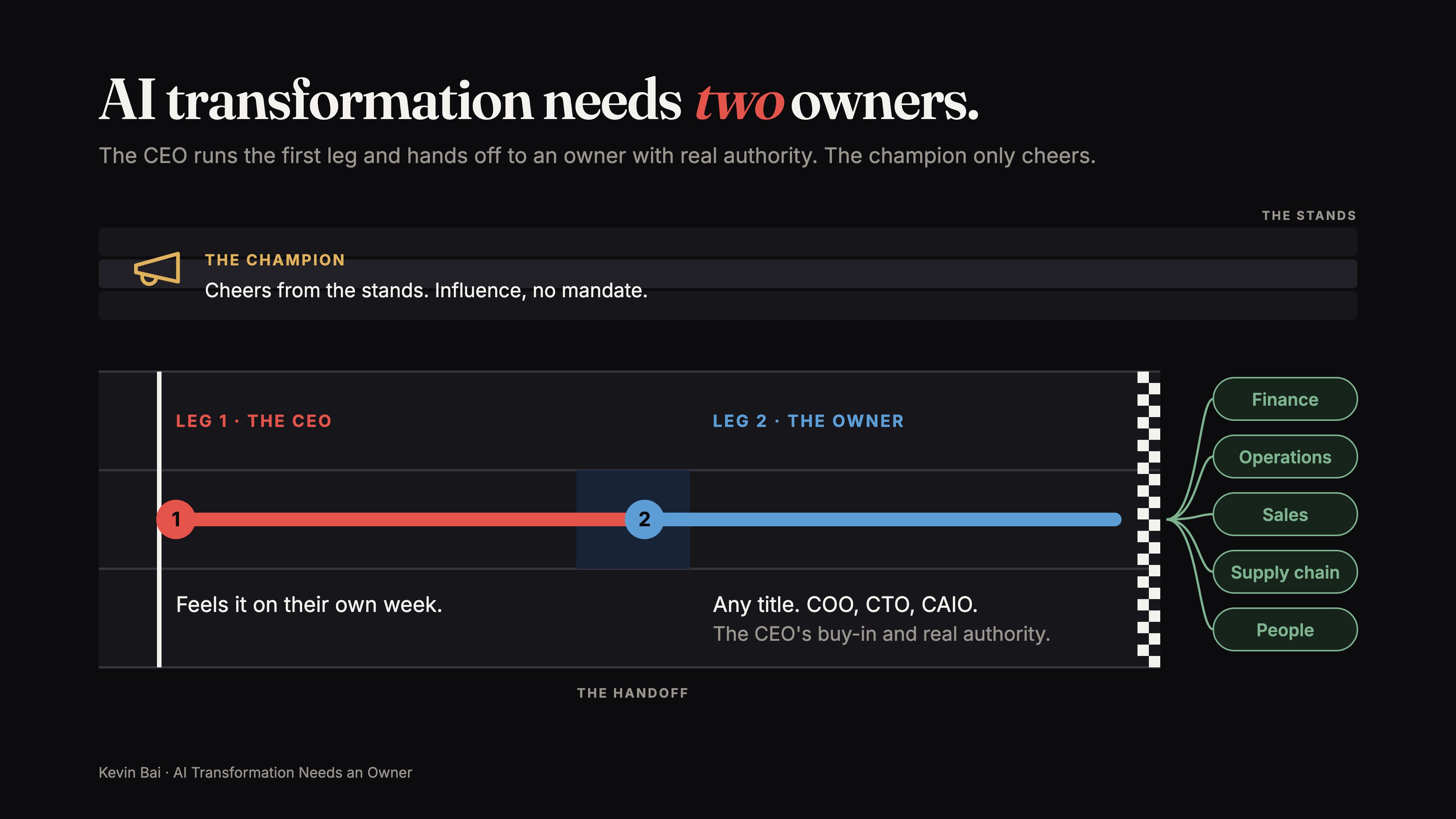
Grass grows where it is watered, and the companies seeing the most from AI were the ones leaning in hardest. An owner is how that investment reaches thousands of people. But the owner carries the CEO's conviction. They cannot supply it. So AI transformation needs two owners. The executive you name is the second. The first is you.
The hard part comes after the demo
Changing how thousands of people work takes far longer than a workshop, and the owner's job is hard in three places.
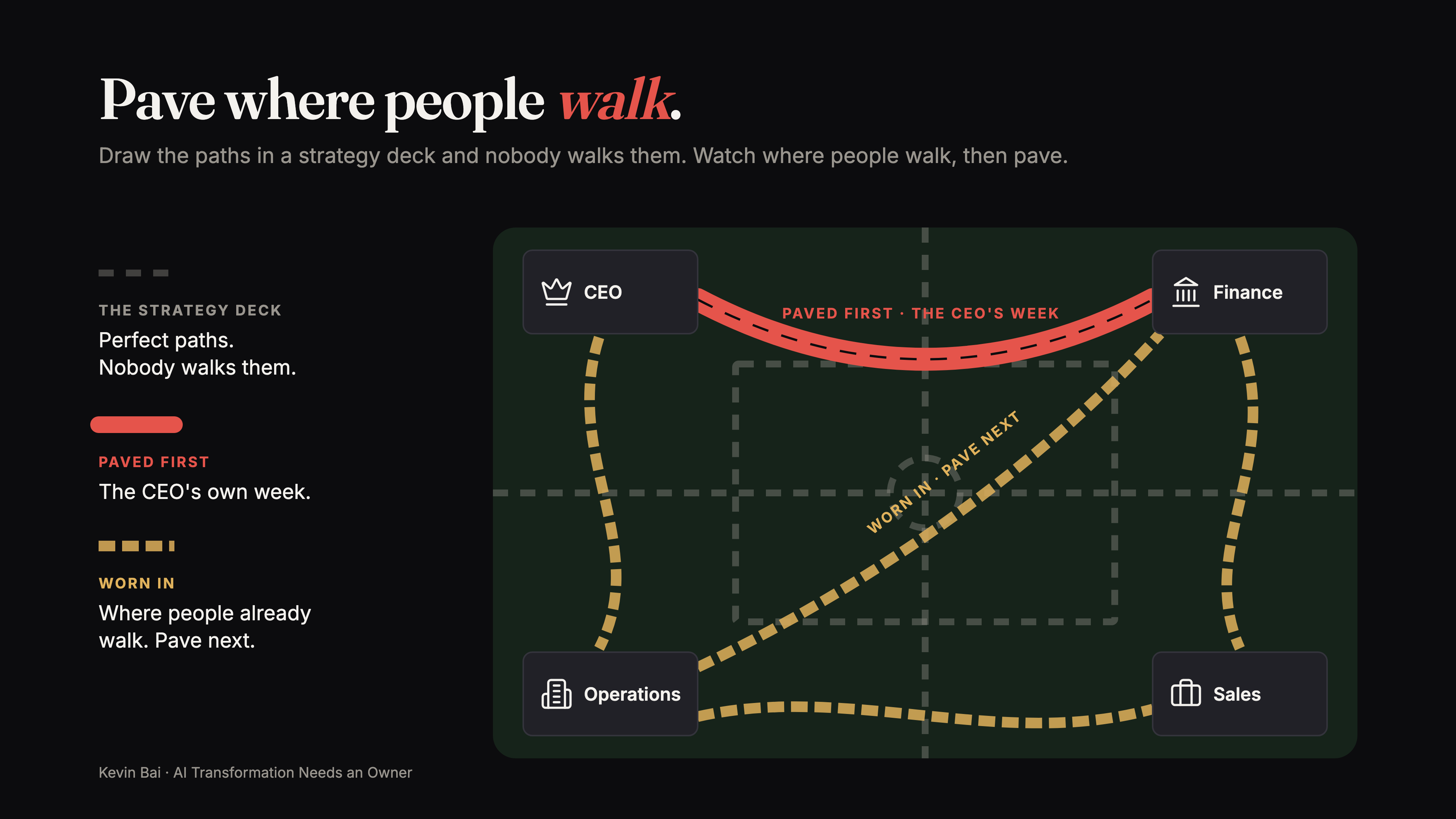
The first is finding the paths. The best model I know is the university that built its quad with no paths, waited to see where students walked, and paved those lines. Most companies draw the paths in a strategy deck instead and wonder why nobody walks on them. The first path is the one the CEO just walked: their own week. The owner's job is to find the next one, and the next.
The second is keeping the work out of two ditches. Some teams never save anything, so every request to the agent starts from zero. Others save hundreds of instructions nobody can find, when what the agent actually needed was access to the system where the answer already lives. Both look like adoption on a usage dashboard. Neither compounds.
The third is the question I heard in every room: what this means for their people. It does not mean, as a blanket rule, that you can or should cut headcount. The purpose of AI is to let your people do far more than they can today. Done well, it leaves you with surplus capacity, and what you do with it is a strategic choice only the CEO can make. Some organizations have grown their teams, because each person now produces so much more that adding people became the obvious move. That choice is one more reason the owner reports to you and not to IT.
One thing to do on Monday
What moved the room was not a tool. It was seeing how much more intelligence they could have at their disposal.
So on Monday, point an agent at your own week. Let it read what you read and prepare what you prepare, and look at what comes back. Become the first owner before you name the second. If you are not a CEO, the move is the same: start with your own work, and let the path form from there.
If you had that much more intelligence available to you, what would you build, and what would you stop doing?
These views do not represent Anthropic.