I never thought I would start an essay about AI by quoting Matthew McConaughey, but here we are.
He opens Salesforce's Claudeforce announcement video with one line: "It's not the end of software. It's the end of software which makes humans do all the work."
I think that distinction matters more than it sounds.
The idea is not that software disappears. It is that the part of software whose job was to make a human navigate the system, find the information, and move the work forward is becoming less important. The system underneath still has to know what is true, what is allowed, and what should happen next.
In other words, the interface can shrink while the system of record becomes more important.
That was the lens I carried through Dreamforce.

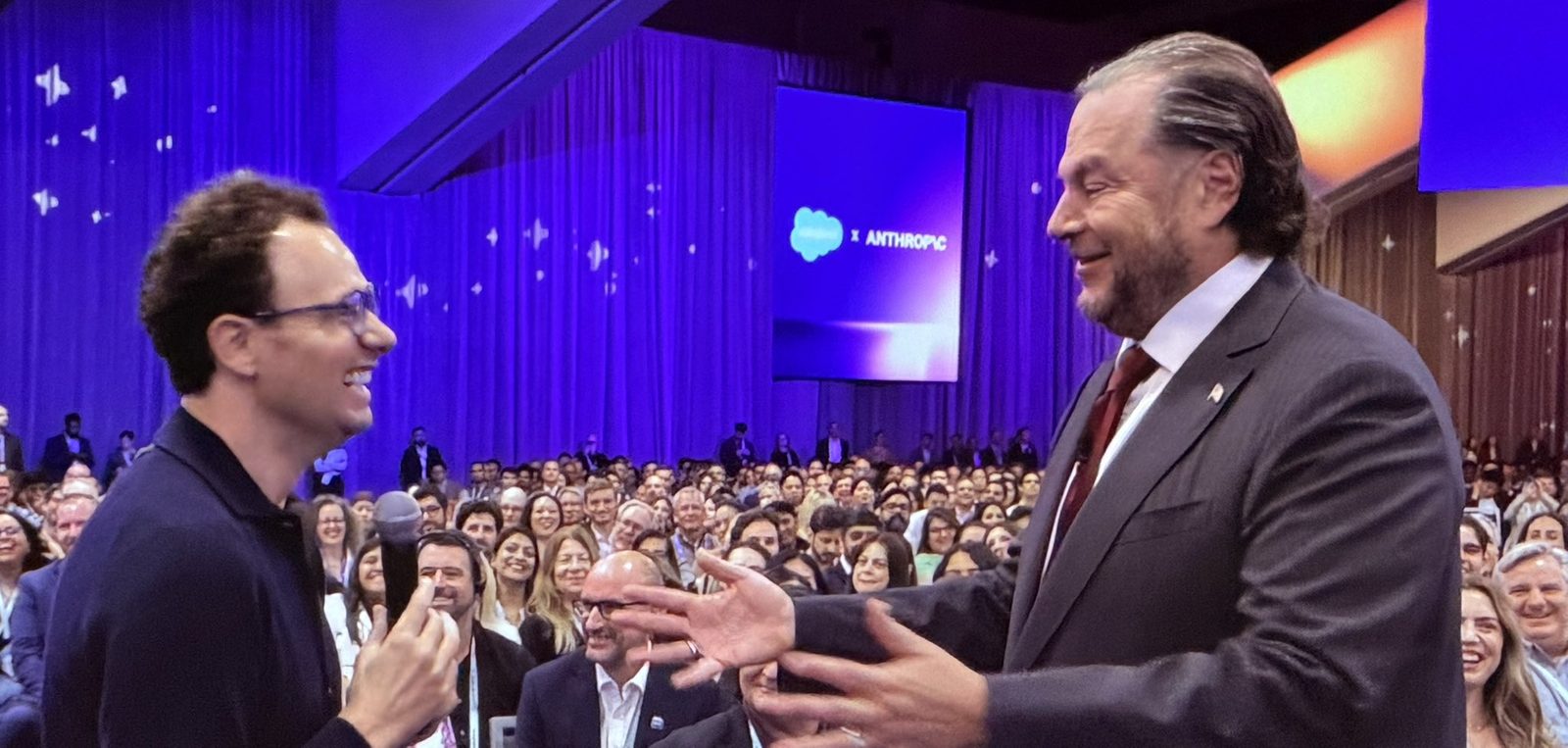
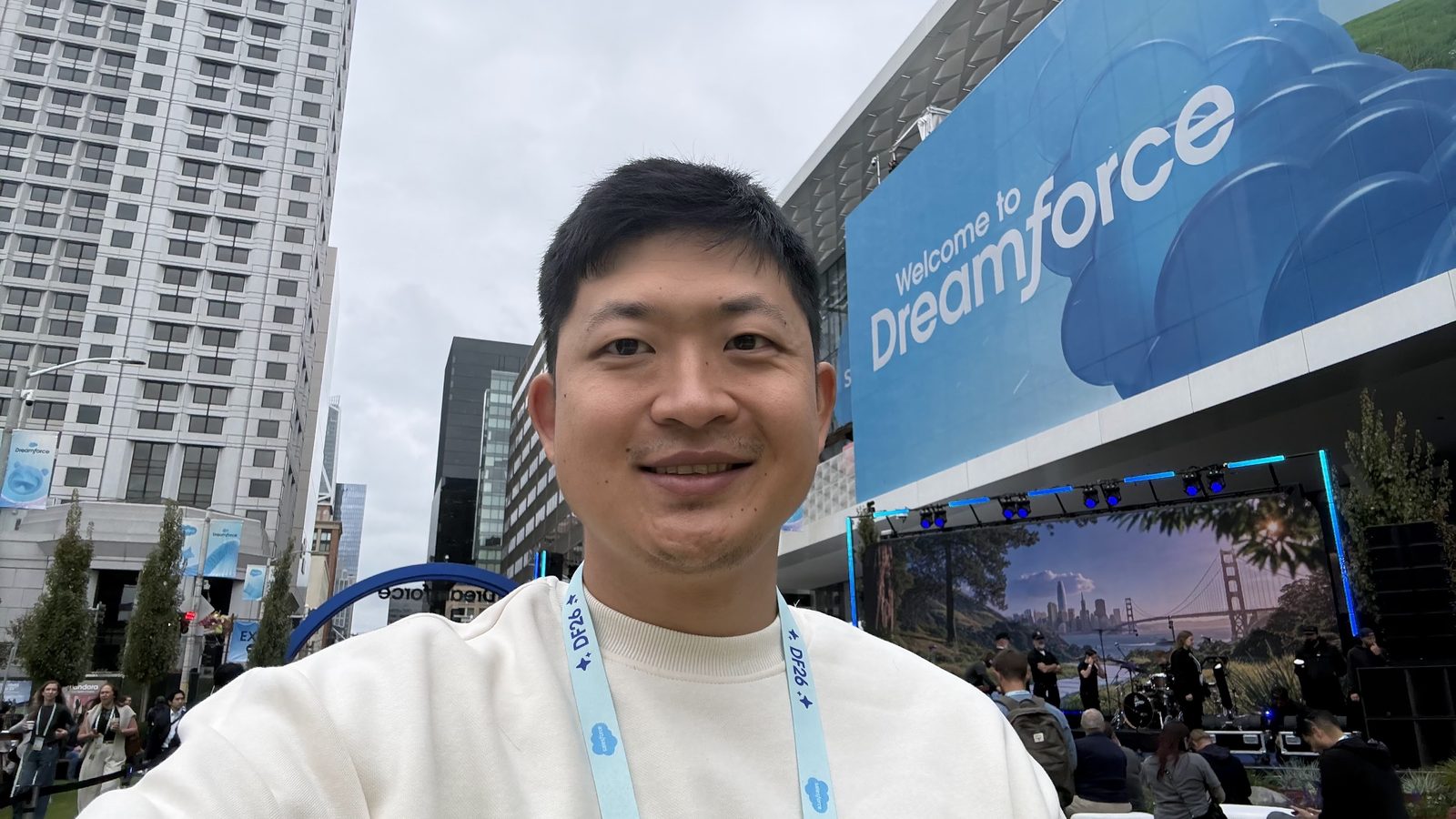
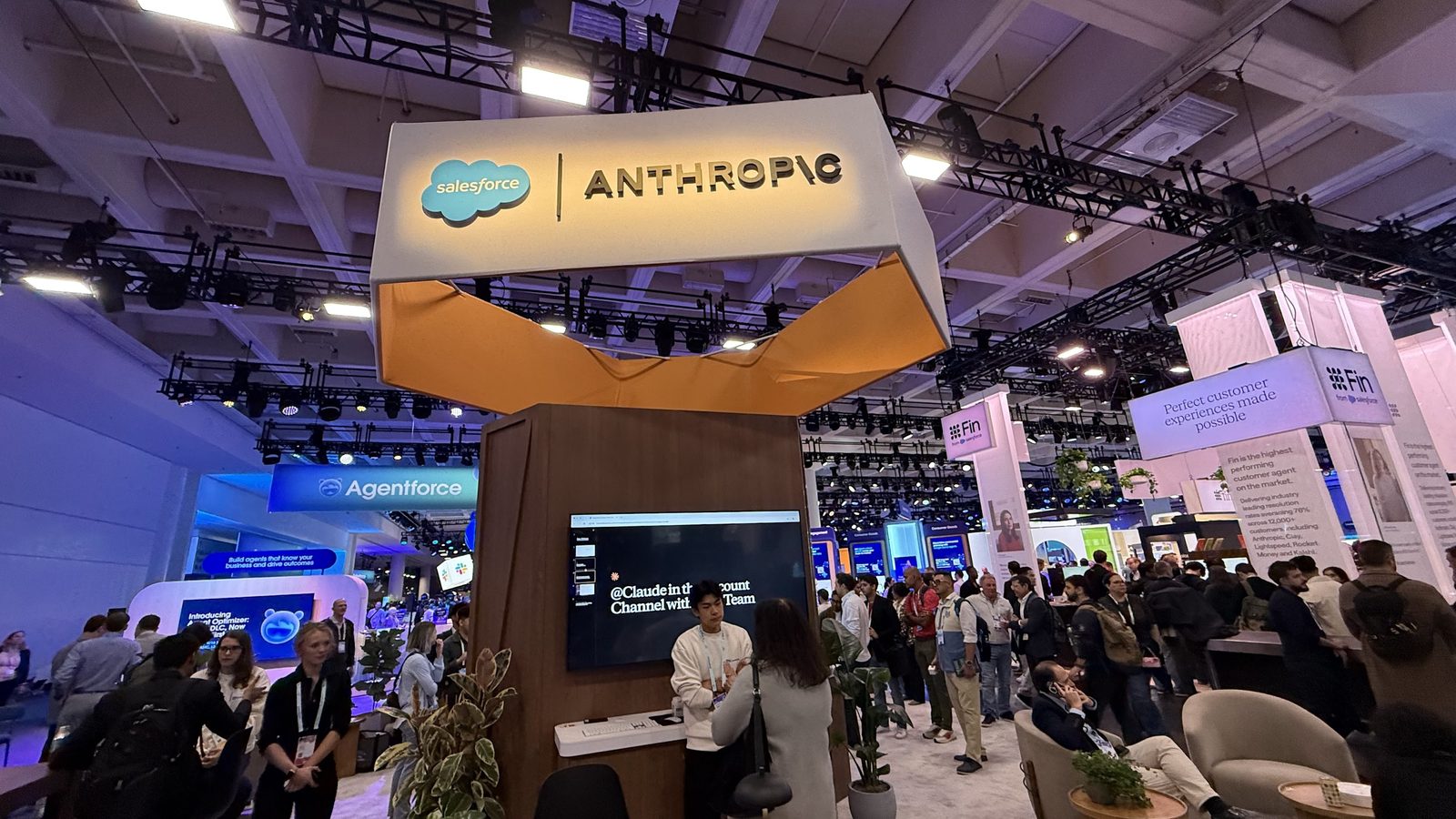
Marc Benioff opened the keynote in front of 10,000 people and brought Dario Amodei on stage to talk about the partnership. Across the week, 53,000 people came through Moscone. I had a session of my own, then spent much of the rest of the week demoing Claudeforce and Claude Tag to hundreds of executives from around the world.
I went to college in the Bay, and every fall Dreamforce seemed to reshape San Francisco for a week. Howard Street closed, the hotels filled, and whatever was announced on that stage set the tone for the industry. I only ever saw it from the outside. So there was something surreal about being on a stage myself, talking to customers about what may be the biggest change to business software since the cloud.
I came away more convinced of something I already half believed: the panic about the end of SaaS has the story backwards.
Software is not ending. The interface and the system underneath it are separating.
Salesforce just showed which half it intends to own.
What Salesforce actually announced
Strip away the keynote staging and the announcement is simpler than it sounds.
Salesforce's new layer is called AIforce. It brings Salesforce data, workflows, and business logic into whatever interface you happen to be using: Claude, Slack, Lightning, or something else. Underneath it sits Data 360, the unified record, alongside Agentforce, the agents that act on that record.
Claudeforce is what this looks like inside Claude. At the center is Salesforce in Claude, an MCP server that gives Claude access to Salesforce data and actions while keeping Salesforce permissions intact.
Benioff called this an "interface revolution." In the teaser, he used another phrase: Headless 360.
The important part is what that implies.
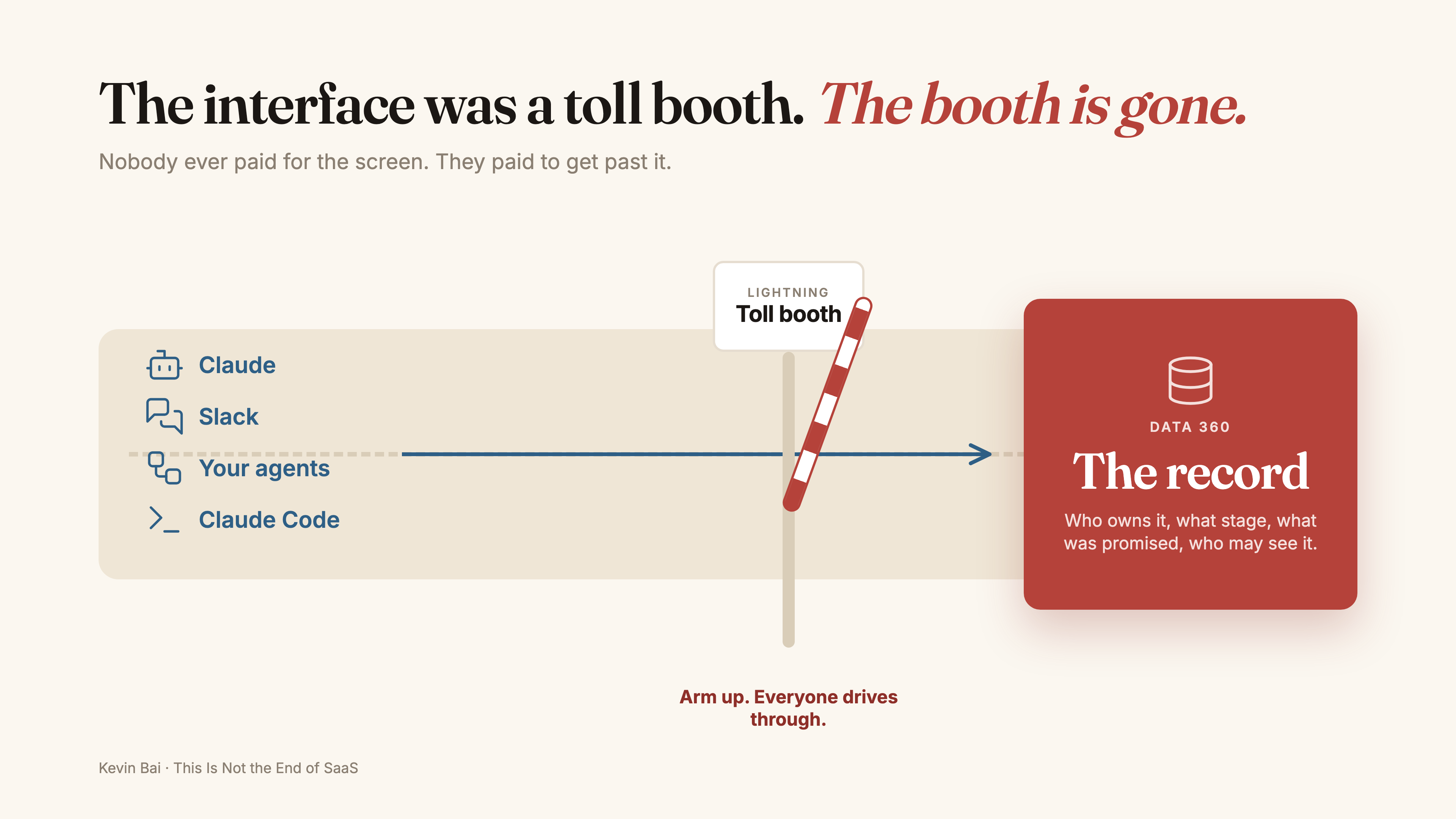
The largest SaaS company in the world is saying that the application you log into no longer has to be the place where the work happens. The data, permissions, workflow logic, and governance remain underneath. The screen becomes one of several places you might interact with them.
That is not the end of SaaS. It is the interface separating from the system of record.
The screen was never the moat
The reaction I heard most often was some version of: if Claude becomes the front end, does SaaS lose?
I think that gets the source of value backwards.
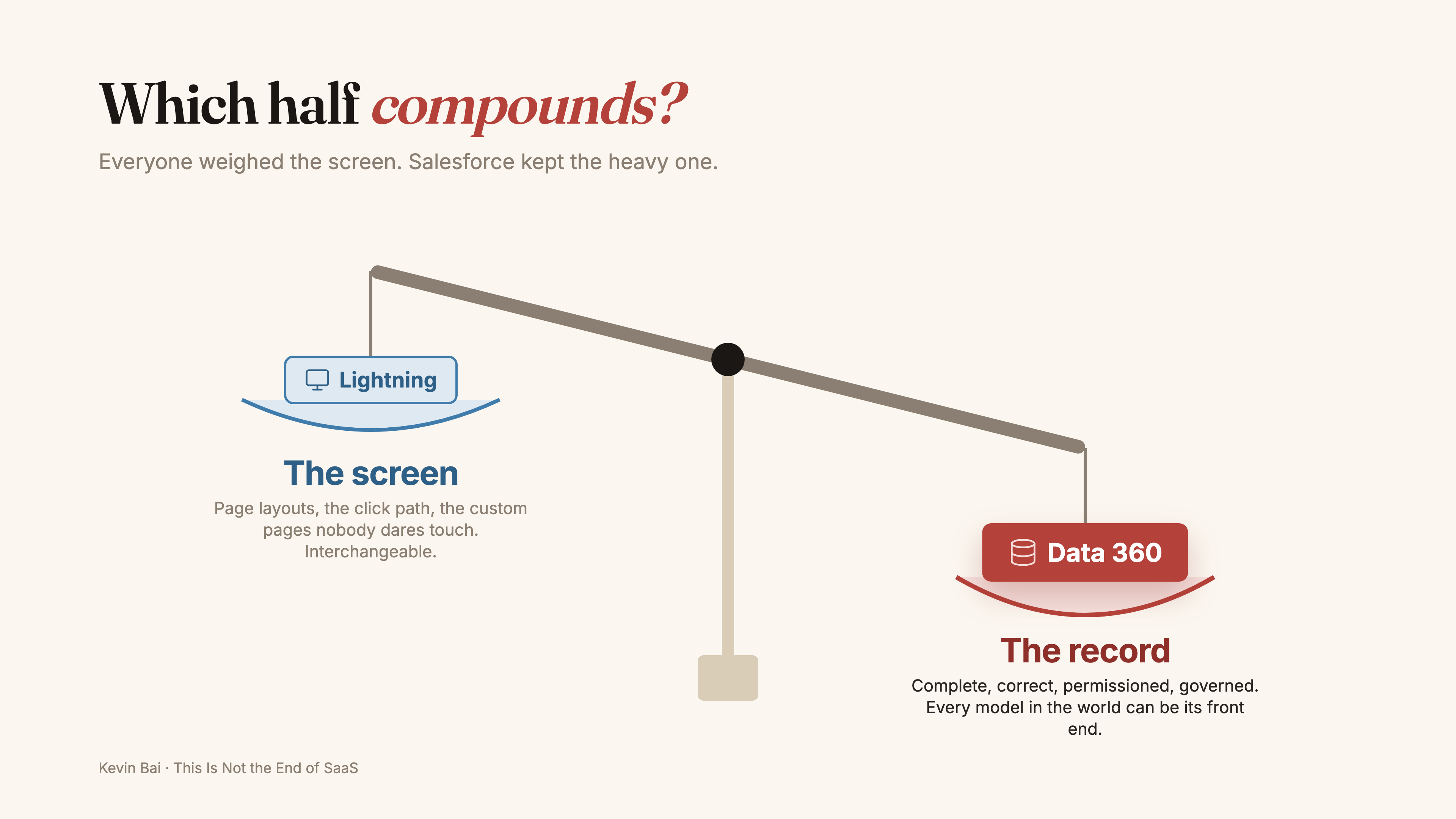
Salesforce's enduring value was never primarily the interface. It is that one governed system knows who owns the account, what stage the deal is in, what was promised, what was invoiced, what changed, and who is allowed to see or edit any of it.
The interface was how humans got to that system.
Now an agent can get there for them.
That does not make the underlying record less important. It can make it more important. An agent drafting a forecast still needs one trusted place to read the pipeline from. An agent updating an account still needs one governed place to write the change. An agent working across the business still needs permissions, auditability, and a shared definition of what is true.
The more work moves to models, the more those models depend on reliable systems underneath them.
So when Salesforce lets Claude become the interface, it is not giving away the valuable part of the product. It is making the interface optional while leaning harder into the part that compounds.
What we are freed from
Anyone who has spent time inside enterprise software knows the tax the interface imposed.
For users, it was the click path. Open the app, find the tab, find the record, scroll the page, open the related list, find the right field, then do it again for the next account. A forecast call could become an hour of people reading screens to each other.

For builders, every custom page and workflow became another surface to maintain. Over time, companies accumulated layers of UI that existed mostly to expose information and actions buried underneath.
There is also a lot of UI that no longer needs to be designed or maintained by a human at all. Screens that existed to expose a record can be generated on demand. That frees designers to spend their time on the interfaces people actually live in, which is where good design was always worth the most.
That interface work made sense when humans had to navigate the system themselves. It matters less when an agent can retrieve the information, take the action, and bring the result to wherever the human already is.
Claudeforce does not need to make every click path better. For many workflows, it can remove the click path entirely.
That is a much bigger change.
What opens up
The most interesting part of the week was not watching Claude reproduce work people already did in Salesforce. It was seeing what becomes possible once Salesforce stops being the destination.
The record becomes multiplayer. Claude Tag puts Claude inside a Slack thread with the people already doing the work. A deal team, Claude, and the account record can all exist in the same conversation. Someone asks what changed since last week. Claude answers from the record. The AE corrects something. The correction can flow back into the system. Everyone sees the same state without stopping to write a separate status update or open another application.
The CRM stops being a place everyone has to visit and becomes part of the conversation already happening.
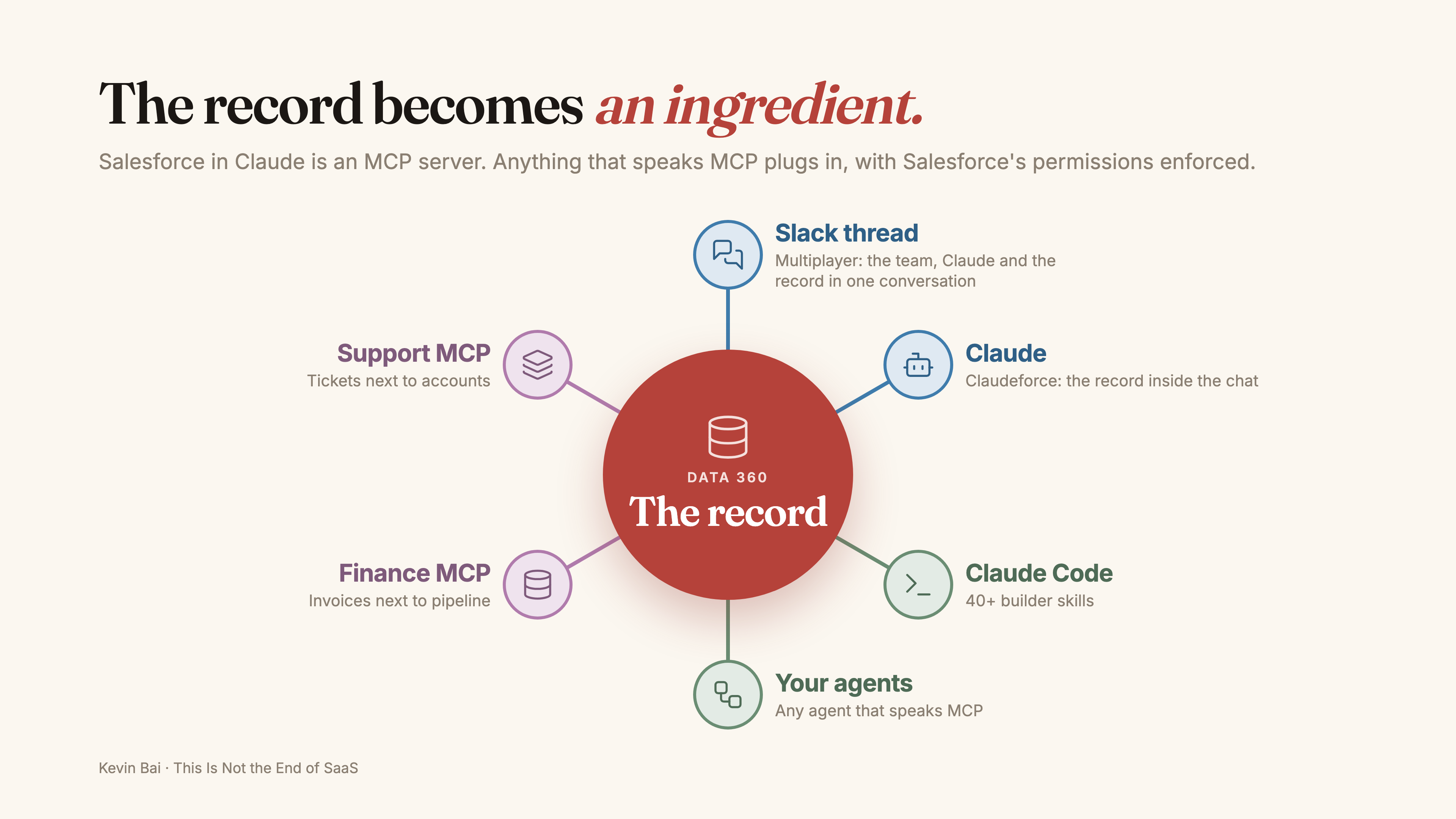
The record becomes an ingredient. Salesforce in Claude uses MCP, which means the Salesforce record can sit alongside the other systems an agent needs to do the job: finance, support, documents, internal tools, and more.
That changes how you can build workflows. Instead of asking one application to own the whole thing, an agent can work across several systems while each one continues to own the data and permissions it is responsible for.
A forecast review might need pipeline from Salesforce, invoices from finance, support history from the help desk, and context from internal documents. Historically, connecting those systems took a lot of integration work. With agents and common interfaces like MCP, coordinating them becomes much easier to build and much easier to change.
The pattern is the same in both cases: the record stops being the destination and becomes infrastructure for everything built on top of it.
That is not a smaller role for Salesforce. It is a larger one.
Being a system of record is brutally hard
"Just be the system of record" sounds like advice to do less.
It is the opposite.
A system of record has to be complete enough that agents do not route around it. It has to be correct enough that agents can safely act on what they find. It has to carry permissions, governance, and auditability because an agent can move through information much faster than a person clicking through screens.
It also has to connect cleanly to the systems around it. Very few important business workflows live inside a single application.
So as the interface becomes more flexible, the bar for the system underneath gets higher. The better the models become, the more valuable trusted data, business logic, identity, permissions, and governance become.
Most software companies were not built for that job. They were built to own a workflow and the interface around it, with enough data underneath to make the workflow work.
The companies that already own a critical record are in a different position. Their opportunity is to make that record more complete, more correct, more connected, and easier for every model and agent to work with.
That position gets more valuable, not less, as models improve.
What hundreds of demos taught me
I spent much of Dreamforce showing this to executives from around the world. What surprised me was how quickly the conversation moved past the novelty of having Claude inside Salesforce.
People did not spend much time asking whether the interface was impressive. They started asking what other systems they could connect, what permissions carried through, what Claude could update, and how this changed workflows that currently crossed three or four applications.
That was the signal for me.
Once people see the interface disappear, their attention moves immediately to the systems underneath it. Where does the data live? Which system is authoritative? What can the agent access? What can it change? What happens when two systems disagree?
Those are system-of-record questions.
And the product direction reflects that. The interface can become more fluid precisely because the underlying record becomes more important.
Which half do you own?
For software companies, I think the question is increasingly simple: which part of the stack actually carries your value?
If you own a system of record, this shift creates a huge opportunity. Make the record more complete, more correct, more governed, and easier for agents to use. Let every model in the world become a possible interface to it.
If you own a workflow, ask what underneath that workflow customers cannot afford to lose. It may be proprietary data, business logic, permissions, network effects, or something else durable. Lean into that.
If the interface itself is the main source of differentiation, the pressure is much higher. Models are getting better at generating interfaces, navigating software, and bringing information to users without requiring them to visit the underlying application at all.
That does not mean every screen disappears. Good interfaces still matter. It means the screen alone is becoming a weaker moat.
McConaughey was right, which is a sentence I did not expect to write. Software that requires humans to do every step of the work is changing quickly. The trusted systems underneath that work are not going away.
The application may stop being where the work happens. The record the work runs on becomes even more important.
That is not the end of SaaS. It is a clearer picture of what SaaS was valuable for all along.
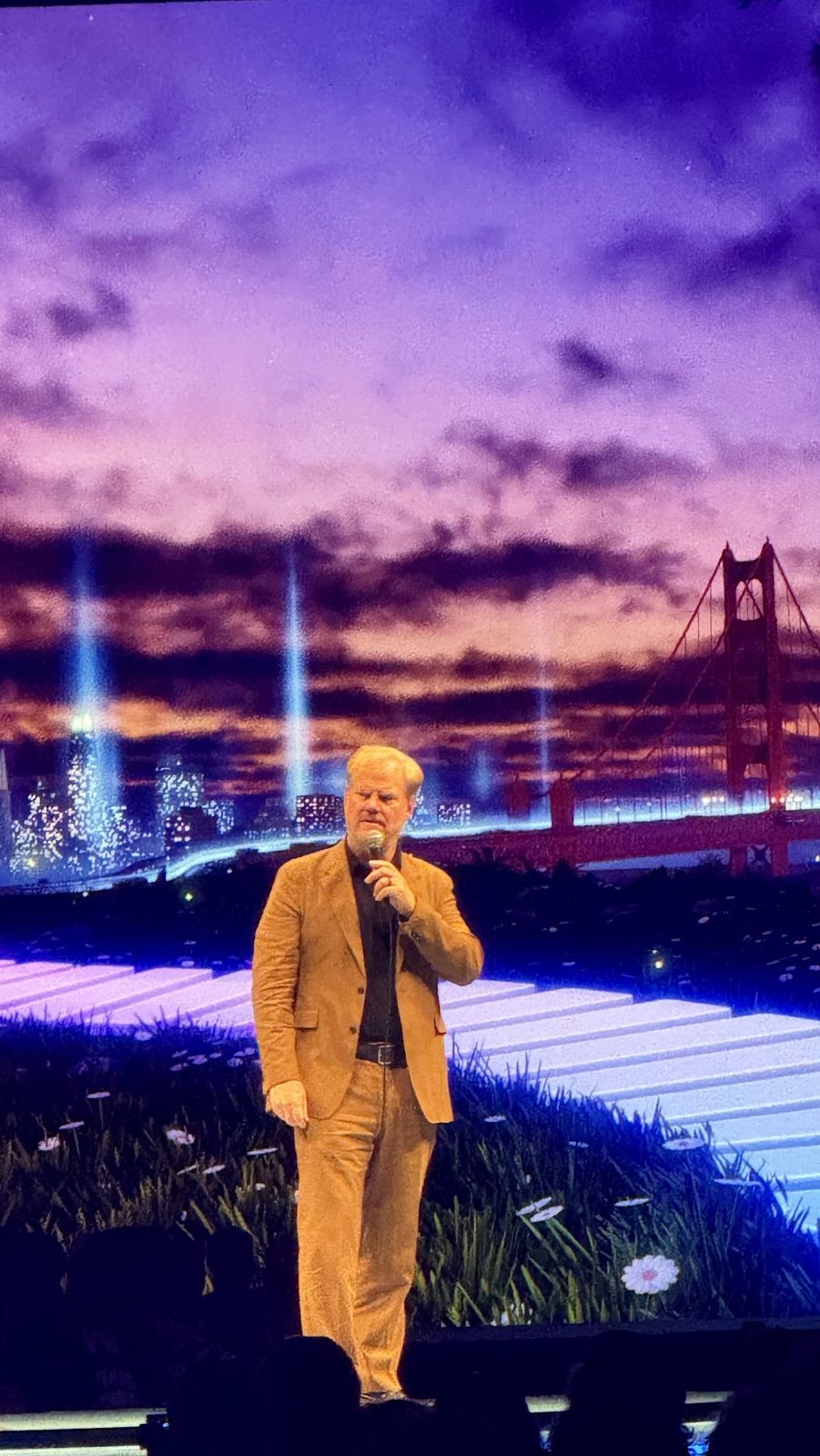
Jim Gaffigan closed out the week, which I'm counting as proof the future still has room for humans.
I work on Anthropic's Applied AI team. The views here are my own and do not represent Anthropic or Salesforce. Nothing here is a commitment to future functionality from either company.